


President Trump: Battleships in the Age of Drones?

Real power or staged dominance: modern warfare is organized around networks of drones and missiles, not single platforms...

The very idea of building a battleship today —even one equipped with missiles and christened the Trump class— inevitably raises fundamental questions: Are we facing a genuine strategic decision… or rather a symbolic gesture anchored in the past? What do history, technology, and —above all— the psychology of power tell us?
The Decline of the Gun as the Axis of Naval Power
During the first half of the twentieth century, the battleship ruled the seas. Its logic was simple: extreme armor plus colossal artillery equaled supremacy. But by the end of the last century, that equation was definitively broken by three technological ruptures.
First came the rise of naval aviation and the aircraft carrier. Then emerged the guided missile, capable of striking targets hundreds of miles away with surgical precision, now hypersonic and increasingly integrated with artificial intelligence, shifting the center of power from the gun to the sky. Finally, in this century, warfare itself has become networked, where quantity, connectivity, and distribution outweigh solid steel.
For decades now, major navies have abandoned the construction of battleships, not out of nostalgia overcome, but out of sheer strategic rationality. The last attempt to prolong their life —the reactivation of the Iowa-class battleships in the 1980s— was a Cold War contingency, not a doctrinal revival.
Satellites, Drones, and Missiles: The Final Blow
Contemporary warfare has definitively closed the chapter of the large gun-armed warship. Today, armed aerial, naval, and underwater drones —guided by intelligent satellites, global positioning systems, and real-time data networks— low-cost autonomous swarms, and precision missiles, including hypersonic weapons, have transformed what was once a symbol of naval supremacy into what no modern strategist desires: a costly, visible, and priority target.
In this new environment, size has ceased to be a strength. It has become a vulnerability. The logic that justified battleships and large platforms throughout the twentieth century —armor, concentrated firepower, intimidating presence— has been defeated by a far simpler and deadlier equation: detect first, strike from afar, and saturate. Today, the objective is no longer to absorb hits, but to avoid them, and only what is small, mobile, and dispersed can do that.
Ukraine: Empirical Evidence No Strategist Can Ignore
The war in Ukraine has demonstrated this transformation of the battlefield in real time, before the eyes of the world. Russia, heir to a military tradition built around large, armored, and costly platforms, has seen tanks, ships, air-defense systems, and strategic depots destroyed or neutralized by relatively inexpensive drones connected to satellite constellations, artificial intelligence, and remote guidance systems, combined with long-range precision missiles.
The sinking of the cruiser Moskva was not merely a material defeat; it was a historical symbol. A large, proud, and highly visible warship was neutralized by exploiting its primary weakness: being detectable, trackable, and predictable from space. The same occurred on land. Adapted commercial drones, loitering munitions, and satellite-guided missiles demonstrated that dominance no longer comes from steel, but from information, coordination, and reach. A costly system can be destroyed by a cheaper one if the former is large and the latter is intelligent.
Missiles: The Definitive Negation of the Battleship
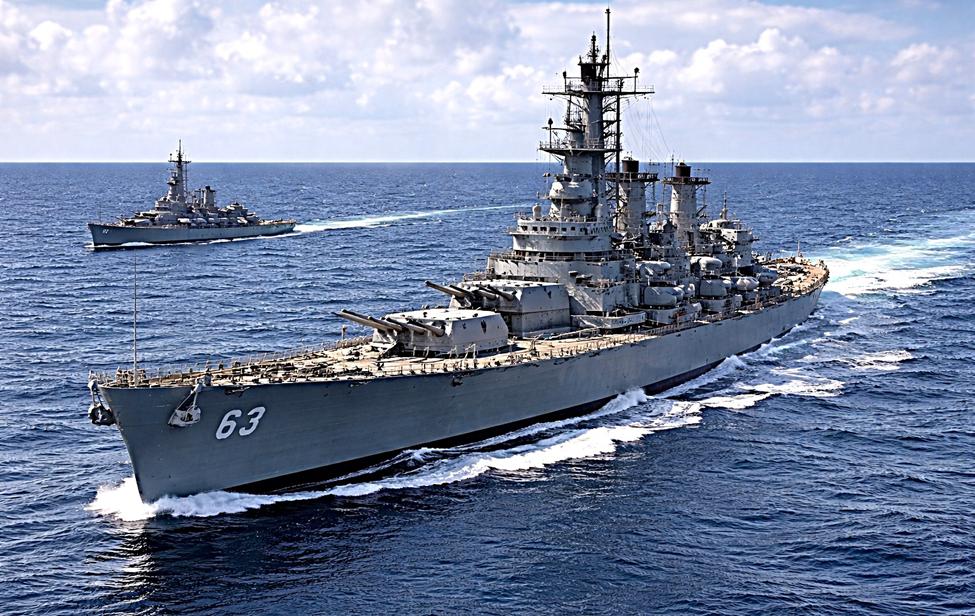
Modern missiles —anti-ship, ballistic, cruise, and hypersonic— represent the conceptual negation of the battleship. They do not need to confront it, approach it, or measure forces against it. They neutralize it from a distance, supported by space-based sensors, remote radar, and distributed command networks.
A missile is not intimidated by the size of a hull. A swarm of aerial, ground, or underwater drones does not stop at armor. A saturation system does not fight the ship, it overwhelms it. Thus, contemporary and near-future warfare does not punish weakness; it punishes rigidity.
And nothing today is more rigid than a large gun-armed warship designed for a world that no longer exists. In the age of drones guided by intelligent satellites and precision missiles, survival belongs not to the biggest, but to the most adaptable, dispersed, and concealed. Steel is no longer destiny.
The Hidden Cost of Gigantism
Building warships —announced as “Trump-class”— already means that a modern destroyer costs between $2 and $3 billion per unit. A new battleship would easily exceed $10 to $15 billion, not counting decades of maintenance, crew, fuel, and protection and costs ultimately borne by citizens.
Each such vessel represents, in opportunity terms, hundreds of distributed platforms: drones, missiles, sensors, and silent submarines, systems that survive even when parts of the whole are destroyed. The battleship, by contrast, lives or dies as a single unit.
The Key Concept: Distributed Power
This is the core of the debate. Modern warfare is no longer organized around single platforms, but around networks. Distributed power means spreading force across many small nodes, separating sensors from weapons, connecting everything through real-time information, and accepting that some nodes will fall, while others continue fighting.
It is the logic of the internet applied to conflict: if one node falls, the network remains alive. The old model relied on a giant lion. The current one trusts a coordinated flock.
So why think about a battleship today? Here the question ceases to be technical and becomes political and psychological.
A Battleship Is Not Just a Weapon: It Is a Symbol
A battleship is designed to communicate grandeur, dominance, historical continuity, and visible strength. It is a floating stage of power, meant to be seen as much as to fight. In this sense, the Trump-class battleship fits more into a personalistic narrative of power than into the cold, technical logic of contemporary national defense.
It does not necessarily prove explicit narcissistic intent, but it does reveal a marked preference for spectacle over efficiency, for image over strategic functionality.

History teaches that leaders overly attached to symbols tend to make a recurring mistake: confusing the appearance of power with its real capacity. And in modern warfare, that confusion is costly.
Henry Kissinger repeatedly warned that the perception of power is a central component of international politics. States do not act solely based on objective capabilities, but on how those capabilities are perceived by allies and adversaries. Yet Kissinger was also clear about something often omitted: perception only works when it is backed by real, credible capability. When the gap between symbol and substance widens, perception stops protecting and starts deceiving.
In the twenty-first century, a battleship may impress public opinion, but it does not intimidate missiles, does not confuse satellites, and does not survive drone swarms. The image of power still matters —Kissinger was right about that— but it is no longer sufficient. When the symbol no longer aligns with the technological logic of its historical moment, it becomes an empty, even dangerous gesture.
Modern warfare does not punish the absence of visual grandeur. It punishes the disconnect between image and reality. And no serious strategy can be built on that illusion.
From this perspective, building a battleship today is a mistake: it does not intimidate missile systems, cannot hide from satellites, cannot survive saturation, and in no way justifies its strategic cost. That is why major powers disperse risk and concentrate intelligence—with the aircraft carrier, for now, as the sole partial exception.
The Illusion of Steel
The real question is not whether the United States can build a new battleship. It can. It always can. The question is why do so when twenty-first-century power is no longer measured in tons of steel, but in adaptability, networks, intelligence, and resilience.
Building battleships in the age of drones is not preparing for the next war. It is reenacting the previous one. And history is unforgiving toward those who confuse a glorious past with a viable future.
Nations do not fall for lack of strength, but for clinging to symbols after the world has changed. Real power no longer floats on a massive hull. It circulates. It distributes. It adapts. And, above all, it does not need to carry anyone’s name to be effective.
On December 22, 2025, President Donald J. Trump announced from his Mar-a-Lago resort in Florida an ambitious plan for the U.S. Navy to build a new class of warships, which he himself called the “Trump-class battleship,” stating that these vessels would be “bigger, faster, and up to 100 times more powerful than any battleship ever built.” He said they would be part of a new “Golden Fleet” aimed at reinforcing U.S. naval supremacy, arguing that the United States had not built battleships since 1994 and that it was time to revive that tradition with a modern approach.
With plans initially to build two ships and potentially between 10 and 25 over the long term, the projected cost to citizens would reach approximately $175 billion at today’s value. The announcement was accompanied by senior officials such as Pete Hegseth, Secretary of Defense, and John Phelan, Secretary of the Navy, who publicly supported the initiative.
When the construction of a supposed new class of battleships is announced, the debate is not ideological, it is technical, economic, and strategic. Wars are not won with narratives, but with systems that survive and function under fire.
There is no doubt these would be large surface warships, more powerful than any previous battleship, as claimed, and part of a symbolically renewed fleet. But they are not convincingly associated with a return to real naval greatness, because no clear strategy or operational doctrine has been presented, nor any defined role in a real war against peer competitors, asymmetric conflicts, irregular warfare, or a distributed, unmanned conflict against us. That alone is a warning sign. The Department of Defense owes the public an explanation.
From our civilian perspective, we are convinced that distributed warfare —as already unfolding— is the real model of the twenty-first century. Its components should be missile frigates, attack submarines, naval, aerial, and underwater drones, satellite sensors, electronic warfare, land-based missiles, and mobile platforms, lower-cost systems with acceptable losses and decisive advantages, because no adversary can ever destroy the entire system. In strictly military terms, there is no competition.

Why Insist on a Battleship?
Here the analysis leaves engineering and enters the psychology of power. A battleship impresses visually, functions as a floating monument, evokes a glorious past, and serves the narrative better than combat. For leaders with a personalized, theatrical conception of power, the symbol outweighs doctrine.
The problem is that missiles do not read speeches, nor do they respect symbols.
Live warfare has already decided this debate. Recent wars —at sea, in the air, and on land— have demonstrated an uncomfortable truth: large, static, slow-moving targets die first. Distributed systems, networks, swarms, and missiles survive. Armies that understand this invest in them, not in monuments.
The Error That Precedes All Defeats

All powers that entered their phase of decline committed, first and foremost, the same fatal error: confusing the image of power with real power. They believed visible grandeur was enough to sustain influence, that symbols could replace capability, and that nostalgia could override historical time.
The battleship belongs to an era when steel decided battles and size commanded respect. Today, information, dispersion, speed, and adaptability decide outcomes. Power no longer concentrates, it circulates. It no longer displays, it hides. It no longer imposes itself by presence, but by anticipation.
Building a battleship in the age of drones, precision missiles, and satellite-guided warfare is not preparing for the next war, especially not building twenty-five of them. It is staging the conflict of the past, erecting floating monuments to a logic already defeated by technology and history.
And history —that implacable judge— never forgives those who invest in symbols after the world has changed. Because defeats do not begin on the battlefield; they begin in the minds of those who cling to yesterday believing they will still govern tomorrow... If you wish to share your opinion or contact us, you can do so at psicologosgessen@hotmail.com. May the Divine Universal Providence guide us all.

This article, or any portion of it, may be published provided that the author are properly credited and the corresponding link


Do liver support tablets work differently depending on how consistently they are used and the person's overall routine?